The new exhibition at the Senckenberg Natural History Museum shows how the smallest finds shape the image of a lost world
A tooth, a bone fragment, a piece of fossilised tree bark: what may seem insignificant at first glance is often the key to great stories for palaeontologists. From 19 September, the special exhibition "Edmond: The Last Days of the Dinosaurs" at the Senckenberg Natural History Museum in Frankfurt will focus on these small finds – and show how they shape the image of an entire era.
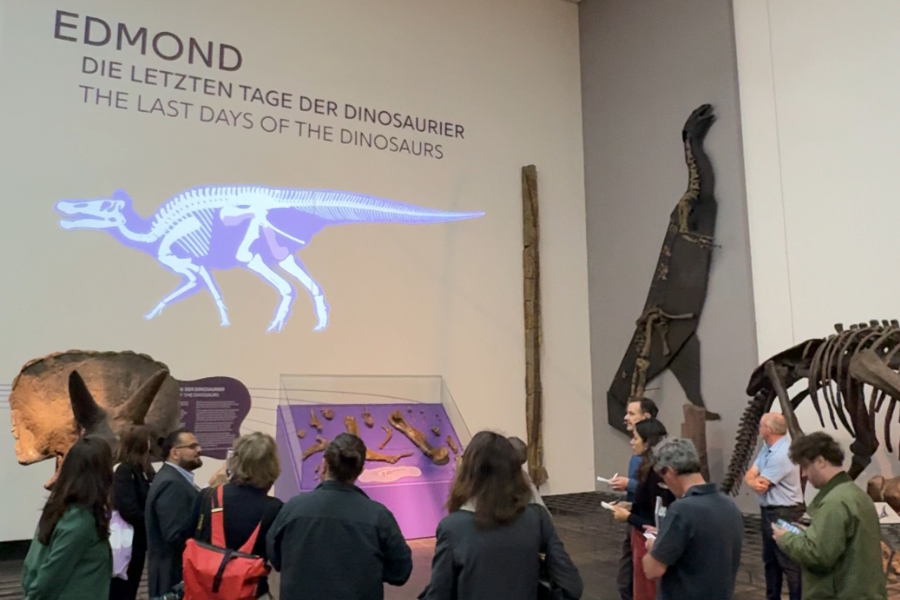
The focus is on "Edmond", an Edmontosaurus, one of the last herbivores before the mass extinction 66 million years ago. The fossil is exceptionally well preserved, even skin impressions are visible. "Edmond is one of our museum's most valuable treasures," says acting museum director Eva Roßmanith. But the exhibition aims to show more than just the spectacular skeleton. "The actual research work is done on tiny fragments that we put together like pieces of a jigsaw puzzle," adds curator Omar Rafael Regalado Fernández.
Bone puzzle from Wyoming
A rock block brought to Frankfurt from Wyoming in 2019 is a special source of information. Researchers found countless bone remains, plant fragments and traces of fossil ecosystems in it. The layers originate from a riverbank in the late Cretaceous period. "One square metre of the block impressively shows how dense the finds are," explains Fernández. The deposits tell of herds of herbivorous dinosaurs, predatory dinosaurs, crocodiles, fish, turtles and frogs – and even of forest fires and seasonal changes. Some bones tell medical histories: for example, injuries to the tail of a hadrosaur indicate arthritis, while damaged teeth of a crocodile of the genus Brachychampsa suggest infections. Bite marks on turtle shells reveal their roles in the food chain.
An ecosystem comes to life
The plant world is also being reconstructed: leaf imprints, seeds and amber provide evidence of a climate that was on average six degrees warmer than today. Cypresses and cycads dominated the landscape. Bone finds of different sizes from the same animal also allow conclusions to be drawn about growth stages and herd behaviour. All the findings are incorporated into a detailed diorama that recreates a scene on the riverbed of Wyoming – with dinosaurs, amphibians, crocodiles and the chirping of cicadas. A large-format digital projection also shows how the bones found were arranged in the body of an Edmontosaurus. Promotion and communication The exhibition is supported by the Lipoid Foundation and the DZ BANK Foundation. "We are thrilled to see how the smallest finds can be used to create an overall picture," says Lipoid Managing Director David Kossen. Kirsten Siersleben from the DZ BANK Foundation emphasises how the Senckenberg Museum brings ancient history to life: "Vividly, digitally and at the same time with a strong connection to the present day."
With "Edmond" and the traces of his contemporaries, visitors not only get a glimpse into the last days of the dinosaurs – but also into the detective work that makes this glimpse possible in the first place.