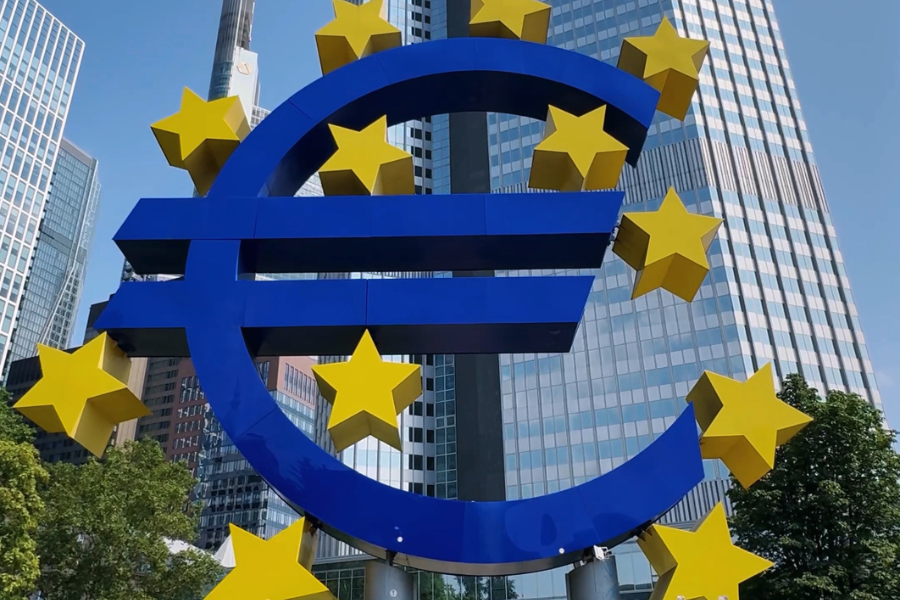
The future of the euro sculpture on Willy-Brandt-Platz has been secured. According to the City of Frankfurt am Main, the European Central Bank (ECB) and Europa Union Frankfurt (EUF), together with the Department for Citizens, Digital and International Affairs, have agreed on a model that will enable the well-known symbol to be preserved permanently. Recently, funding had been uncertain after private sponsors pulled out.
The 14-metre-high installation by artist Ottmar Hörl was erected in December 2001 to mark the introduction of the euro. It was initiated by economic historian Manfred Pohl, whose Frankfurt Cultural Committee had previously owned the sculpture. The EUF is now taking over ownership, while the city and the ECB will cover the running costs with annual subsidies in future.
According to its own statements, the department headed by Eileen O'Sullivan had coordinated a solution in recent months to preserve the landmark in the heart of the city. O'Sullivan pointed to the importance of the euro as the common currency of currently 20 countries, and expected to be 21 from 2026: "It unites us in the European Union. It greatly facilitates international mobility and economic activity." The euro sculpture is one of Frankfurt's most photographed motifs and a visible sign of international solidarity.
The chairman of Europa Union Frankfurt, Klaus Klipp, also emphasised its symbolic power: the euro symbol is understood worldwide and stands for the unity of Europe as well as Frankfurt's role as a European centre. ECB President Christine Lagarde explained that the sculpture embodies the idea of a united Europe and at the same time reflects the work of the central bank. She said she was pleased that a viable solution had been found that would ensure its preservation for the many visitors. The previous owner, the Frankfurt Cultural Committee, had financed the sculpture from private funds since its erection. According to Pohl, there were sufficient sponsors until 2020, including citizens of the city and financial institutions. However, over the past five years, it had become increasingly difficult to cover the annual repair and maintenance costs through donations. The city had therefore negotiated intensively with potential supporters to ensure the sculpture's continued existence.
The Europa Union Frankfurt, which will take over responsibility in future, is a non-profit and non-partisan association of young Frankfurters who are committed to a strong, federal Europe. For them, the sculpture represents not only European integration, but also the international character of the city.