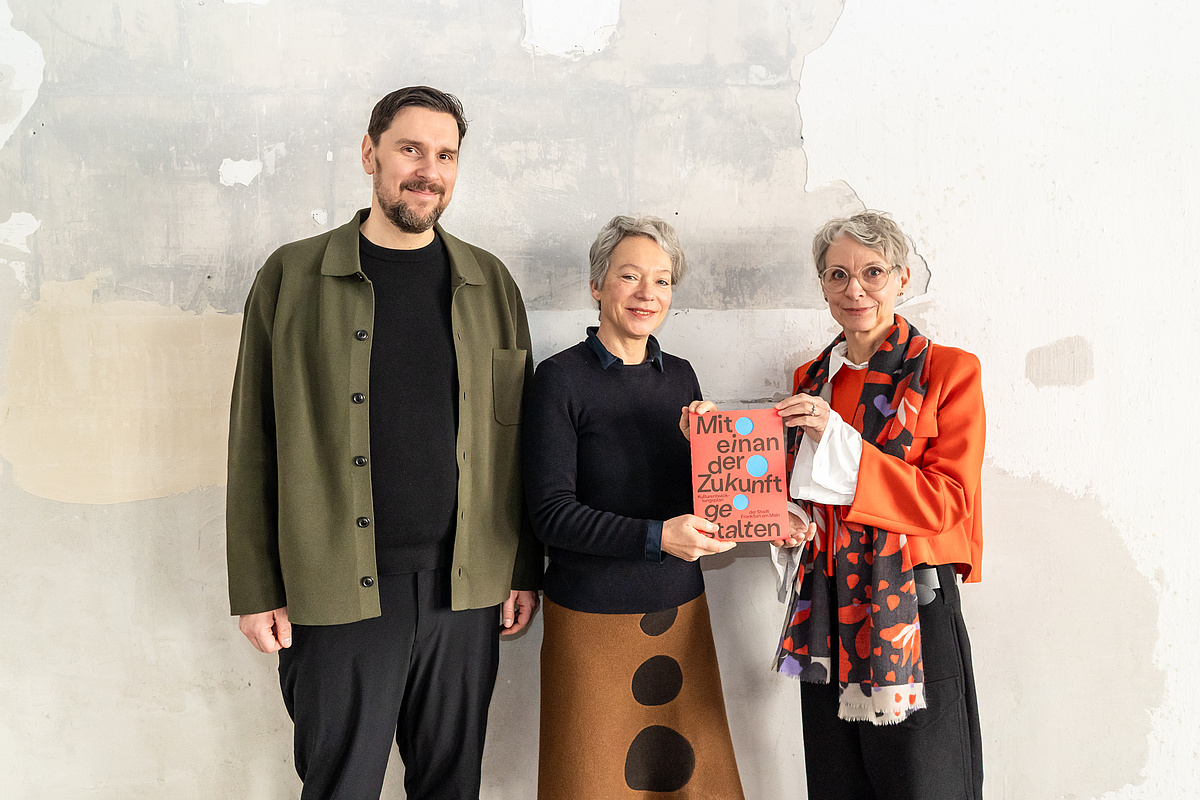
The city of Frankfurt has presented its first comprehensive cultural development plan (KEP). Head of the Department of Culture Ina Hartwig (SPD) presented the paper on Wednesday together with the head of the Cultural Office, Sybille Linke, and external process facilitator Patrick S. Föhl. The plan is the result of a four-year participatory process and is intended to form the strategic framework for the city's cultural policy development in the coming years. The KEP was developed between 2021 and 2025 with the involvement of cultural institutions, independent cultural professionals, experts from related disciplines and interested citizens. The city describes it as a broad-based, participatory process. The plan defines guidelines, fields of action and measures with which Frankfurt intends to respond to social and cultural transformation processes. Hartwig described the KEP as a "milestone for the future of culture" in Frankfurt. Culture is a central factor in social coexistence, but at the same time is itself affected by profound changes. The plan now presented marks the provisional conclusion of a process that aimed to "set the course for the future development of culture in our city". Broad participation was deliberately chosen because a major international city like Frankfurt faces "diverse and complex challenges".
Methodologically, the Cultural Development Plan is based on a three-stage process consisting of an analysis, participation and conception phase. Various formats of survey and participation were used, including experimental approaches such as the so-called "kep.lab". Föhl, head of the Cultural Consulting Network, sees this as an example of a new generation of strategic cultural planning. The Frankfurt plan is designed to initiate concrete transformation processes and attract attention beyond the city. In terms of content, the KEP focuses on several key areas. These include strengthening cultural participation, especially for previously underrepresented groups, dealing with the opportunities and risks of digitalisation, and improving working conditions in the independent cultural scene. Hartwig explicitly referred to the cultural policy leitmotif "Culture for All" of her predecessor Hilmar Hoffmann, but pointed out that social conditions had changed considerably since the 1970s. Frankfurt's cultural diversity is much greater today, which requires new forms of communication and participation.
The Cultural Development Plan also has consequences for the city administration itself. Head of the Cultural Office Linke emphasised that the KEP is the result of a co-creative process involving politics, administration, the cultural scene and urban society. The Cultural Office will play a central role in its implementation, particularly as a moderator of further coordination processes. To this end, the structures of the office will be further developed; a new cultural development department has already been set up. The Cultural Development Plan is designed as a "rolling plan". Measures and priorities are to be regularly reviewed and updated in order to be able to respond to changing political or social conditions. In this way, the KEP is to retain its function as a guiding document for cultural policy in the long term.