The city wants to fundamentally realign the traditional zoo with a three-pillar concept. Animal husbandry, nature conservation research and cultural education are to be more closely integrated in future.
Frankfurt Zoo is facing a comprehensive reorientation. With the so-called three-pillar concept, the city council has now decided on a long-term programme that is intended to make Germany's second-oldest zoo sustainable in terms of its structure, content and institutional framework. The zoo is not only to be renovated, but also redesigned as a modern educational and experiential venue – at the interface of animal husbandry, science and culture.
Ina Hartwig, head of the city's cultural affairs department, speaks of a necessary step. The zoo is getting on in years, but at the same time it is a central location for leisure, education and communication in a growing city. "Beyond the purely structural aspects, we want to develop our zoo into an even more modern and diverse place in the long term," says Hartwig. The three pillars of the concept are the Zoo Master Plan, the Frankfurt Conservation Centre and the renovation of the Zoo Society House with a municipal children's and youth theatre.
Habitats instead of individual enclosures
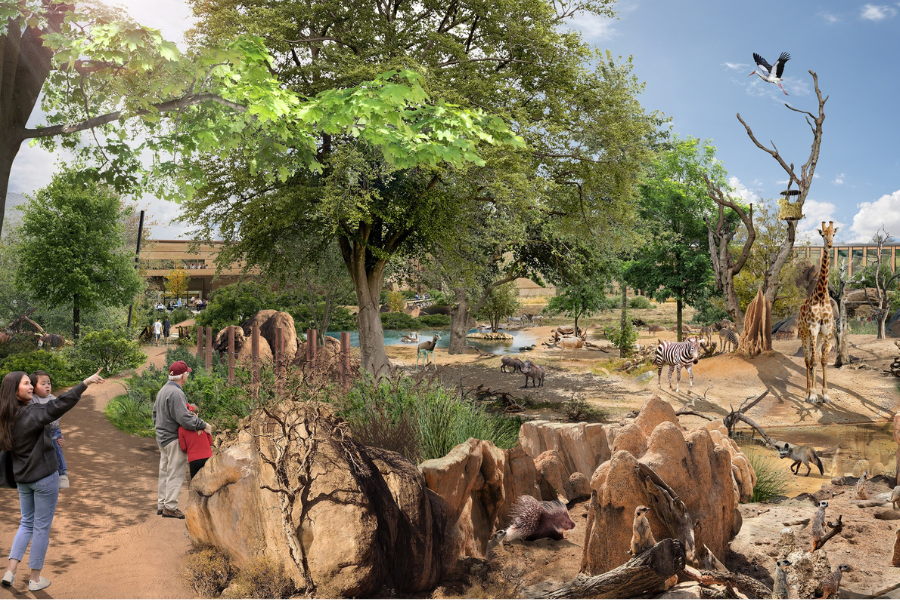
The core of the first pillar is the Zoo Master Plan. The grounds are to be redesigned in several construction phases. Classic, separate animal enclosures are to be replaced by large-scale landscapes that replicate entire ecosystems. The aim is to show animal communities as they occur in their natural habitats. Zookeeper Christina Geiger speaks of a paradigm shift. "Our visitors should be able to immerse themselves in the world of animals," she says. The so-called immersive zoo design blurs the boundary between humans and animals. Proximity and direct experience are intended to generate fascination – which in turn can be harnessed for educational and conservation purposes.
Three large landscapes are planned, which also reflect the work of the Frankfurt Zoological Society (ZGF). The first will be an African savannah modelled on the Serengeti, with which the zoo and the ZGF have a long association. In later construction phases, Lomami in Congo and Manú in Peru will be featured as further protected areas from the rainforest and Amazon regions.
A global centre for nature conservation
The second pillar extends beyond the zoo. The Frankfurt Conservation Centre (FCC) is to be established on the zoo grounds as an internationally networked centre of excellence for integrated nature conservation. Under the leadership of Goethe University, the Senckenberg Society for Nature Research and the Frankfurt Zoological Society, science, teaching and practice are to be more closely linked. The background to this is the growing urgency of global ecological crises. "Over the past 50 years, we have lost around 70 per cent of the world's wildlife and vertebrate populations," says Christof Schenck, Managing Director of the ZGF. Species extinction and climate change threaten the natural foundations of human life. The FCC aims to research these developments, pool global data on biodiversity and ecosystems, and develop solutions – with the aim of anchoring nature conservation more firmly in politics, business and society.
Cultural education at the zoo entrance
The third pillar concerns the zoo clubhouse at the main entrance to the zoo. The listed building is to be renovated and will house several functions in future: the zoo administration, the zoo school and its own municipal children's and youth theatre. Given the growing number of children in Frankfurt and the region, the need is great, says Hartwig.
The Young Theatre Workshop at the zoo already demonstrates the potential of the location. The plan is to create an open house for young people here, developed in collaboration with the independent scene. International guest performances are planned, as well as regional and national co-productions, workshops, participatory programmes and a variety of artistic formats. "It should be a place where young people can experience and help shape theatre for their age group," says Liljan Halfen, director of the Young Theatre Workshop. With the approval of all three pillars, the head of the cultural department sees the zoo on a new course. According to Hartwig, Frankfurt Zoo can now be "comprehensively and well thought-out developed for future generations". The traditional zoo is to become an institution that combines animal husbandry, research and cultural education – and thus formulates a claim that extends far beyond Frankfurt.